My Account


RSS
oZone3D.Net RSS Feeds»RSS 2.0 Feeds

Blogs
»Demoniak3D Blog
»JeGX's Infamous Lab

Sponsors


Modul8: real time video mixing and compositing


Link to Us

oZone3D.Net 100% Realtime 3D

»All Links

Web Partners

www.geeks3d.com
www.benchmarkhq.ru
www.tdt3d.com
www.steph3d.net
www.g-truc.net
www.worldpcspecs.com


Banners Exchange

www.jmax-hardware.com
cgindia.blogspot.com
grapejuice.c.la
www.game-lab.com


Links Exchange

»CYGAD's 3DXtra

Search
Google
Web
oZone3D.Net
 
Image Filtering with GLSL - Convolution Kernels

By Jérôme 'JeGX' Guinot - jegx [at] ozone3d [dot] net

Initial draft: December 8, 2005
Last update: January 8, 2006


Translated from french by Samir Fitouri


[ Index ]

Introduction | Page 2 | Page 3 | Page 4 | Page 5 | Page 6 | Page 7

»Next Page


Stumble it! | | | |


1 - Introduction

2 - Gaussian Filter

3 - Mean Filter

4 - Laplacian Filter

5 - Emboss Filter

6 - Sharpness Filter

7 - Further Reading

8 - Downloads


1 - Introduction


In this tutorial, we will see how to implement in GLSL (OpenGL Shading Language) the filters usually used in image processing: blur (Gaussian Filter), de-dusting (Mean Filter), edegs detection (Laplacian Filter), emboss and sharpness. All these filters are found in all image processing softwares (Photoshop, Paintshop Pro...).

OpenGL Logo


The convolution is an operation in which the final pixel is the weighted sum of the neighboring pixels. This convolution operation is based on a matrix which gives some weight to each one of the neighbor pixels. This matrix is called convolution kernel. This matrix is a square 3x3, 5x5 or 7x7 dimension matrix (or more depending on filters). In this tutorial, we will use 3 dimension kernels.

The convolution kernel is also called linear filter.

The various filters are implemented in GLSL, which is the shading language supported by Demoniak3D. Do not forget to download the latest version of Demoniak3D in order to be able to run each project. The projects are downloadable at the end of this page.

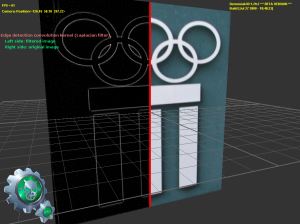
The image which will be used to illustrate the operation of the various filters is the following one:
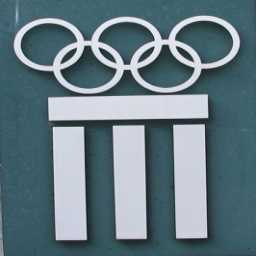

Fig.1 - Basic image.

And now, let us see the filters codes.


[ Index ]

Introduction | Page 2 | Page 3 | Page 4 | Page 5 | Page 6 | Page 7

»Next Page


Language:


Demoniak3D
Current Version: 1.23.0
»Demoniak3D
»Download
»Libraries and Plugins
»Demos
»Online Help - Reference Guide
»Codes Samples


GPU Caps Viewer
Current Version: 1.5.2
»GPU Caps Viewer
»GPU DB Submissions


FurMark
Current Version: 1.4.0
»FurMark
»Benchmark Submissions


PhysX FluidMark
Current Version: 1.0.0
»PhysX FluidMark
»Benchmark Submissions


Geeks3D News


Sponsors


Visitors Map

Page generated in 0.10995101928711 seconds.